
Entrepreneur vs Businessman: What's the Difference & Similarities

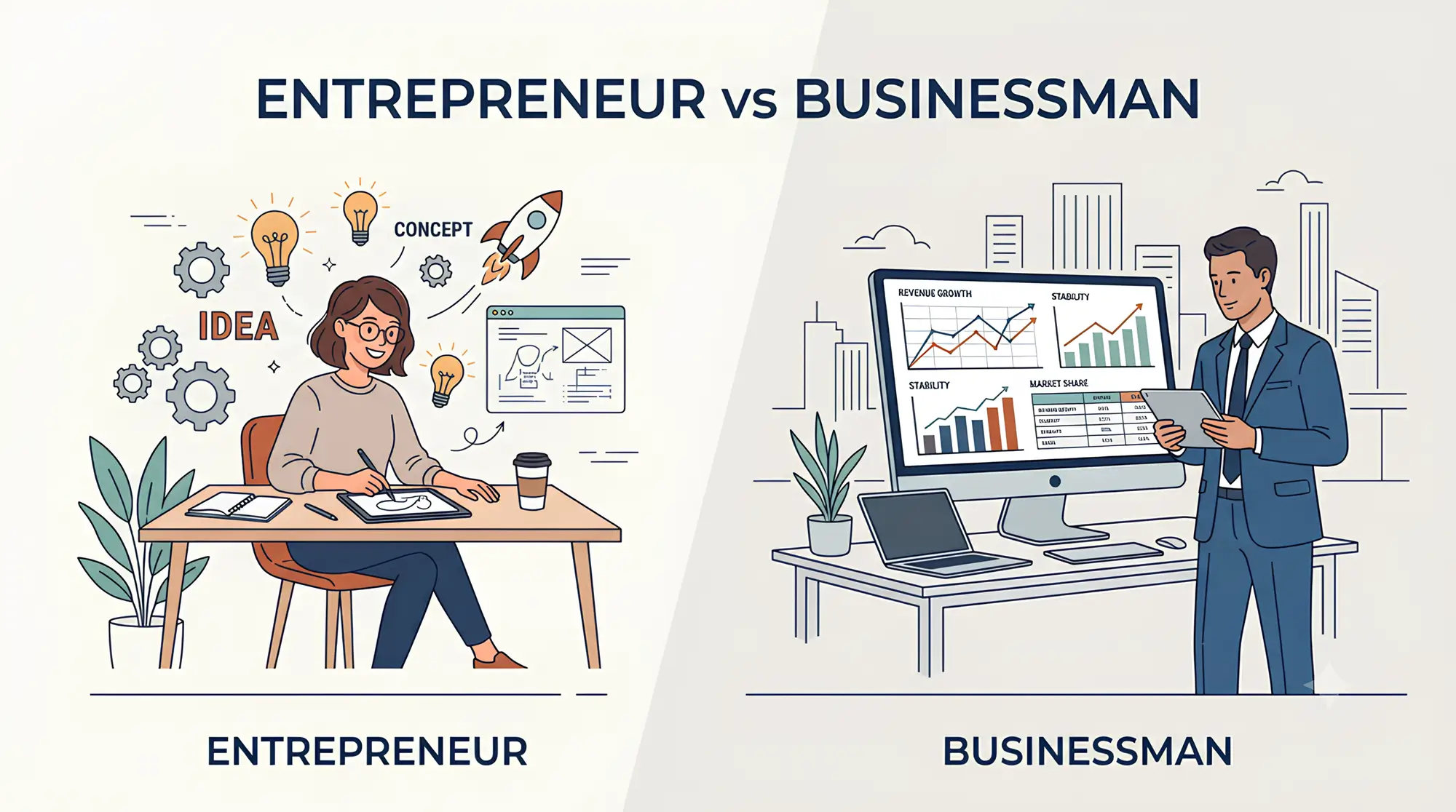
Imagine two people at the same networking event. One is sketching a half-baked app idea on a paper. The other is calmly explaining to you how he/she generates monthly income from three successful businesses. Both are described as "business people," yet they are doing fundamentally different work. This highlights the key difference between an entrepreneur and a businessman—a difference that can easily be misunderstood by anyone, whether a student, a founder, or a seasoned professional.
People often use these terms interchangeably, assuming they are the same, but they are not. Understanding the role of an entrepreneur and a businessperson enables you to make informed decisions, as there are differences in their working styles, mindsets, and impact on the market. This guide explores how leadership connects entrepreneurs and businesspeople, while also examining the differences and similarities between the two roles. Grab your coffee. This one's worth it.
Who Is an Entrepreneur?
An entrepreneur sees the need and fills it. View them as builders of new products, new services, and even new product categories. Well, then what does an entrepreneur do all day? They test out ideas, raise money from investors, pivot when customers express dissatisfaction with something, and handle a variety of tasks in their daily routine. Profit is important, but the mission is often more important.
Key Characteristics of an Entrepreneur
-
Visionary: Perceptive of opportunities others miss. When others complain about a problem, an entrepreneur thinks about how to create a product that will solve it.
-
Comfortable with uncertainty: Tolerates ambiguity and remains calm even when things are not clear. Salary is not guaranteed; there is no roadmap, no problem. They have experience making decisions with only half the information.
-
Relentlessly curious: Continually asks "what if" and conducts small experiments to discover the answer. It is better to create a quick prototype or test campaign than to spend months overthinking.
-
Resilient: Takes a disappointing launch as feedback for the next attempt. They ask themselves, "What did we learn?" and then get to work, rather than "Why me?"
-
All-in: Risks their time, money, and sleep on a concept that has yet to be confirmed. It’s the kind of dedication that sustains a nascent concept until it can grow into a viable business.
In short, an entrepreneur is a builder of the new, driven by vision and never by certainty.
Who Is a Businessman?
A businessman operates or invests in a business that functions according to an established model. He doesn't create the market; he works within it, adding, removing, managing, and optimizing. So, what does a businessman do? He maintains operations, reduces costs, negotiates, leads, and ensures revenue exceeds expenses. It's not so much about the lightning-bolt idea as it is about the smoothly operating machine.
An entrepreneur seeks the possible, while a businessman perfects the existing; that's the first clue.
Key Characteristics of a Businessman
-
Practical and numbers-driven: Makes decisions based on data and quantifiable returns. It's not all about instincts and feelings; margins, cash flow, and ROI dictate every action.
-
Stability-focused: Prefers tried-and-tested approaches to new experiments. He'd prefer to tweak a method that has been successful for years rather than change it.
-
Sharp negotiator: Maintains a deep network of suppliers, customers, and partners. Good relationships result in better prices, quicker deals, and fewer surprises.
-
Natural planner: Likes to plan rather than jump around. Before taking any major action, he prepares financial forecasts, budgets, and contingency plans in advance.
-
Profit-minded: Interested in both reducing the risk of failure and maintaining a consistent income stream, not changing the rules of the game. The aim is to have a business that will be viable for decades, not just for a year.
In other words, a businessman is a manager of a functioning entity who is dedicated to transforming a successful formula into profitable earnings.
Entrepreneur vs. Businessman: What's the Difference?
Now to the main part. The difference between an entrepreneur and a businessman shows up in working style, risk-taking, and the definition of success. Let's take a quick look at the comparison before we get too deep.
| Factor | Entrepreneur | Businessman |
|---|---|---|
| Mindset and Approach | Visionary and experimental; asks, "What could exist that doesn't yet?" | Practical and strategic; asks, "How can we run the business more profitably?" |
| Innovation and Creativity | Innovation is the engine; develops new products, services, and processes. | Uses creativity to enhance efficiency within the existing model. |
| Risk-Taking | Takes high risks, frequently betting on unproven ideas. | Calculates risks and puts precautions in place. |
| Approach to Opportunities | Sees opportunities and takes action to meet unmet needs. | Assesses and pursues opportunities that are already in place. |
| Growth and Scalability | Aggressive and scale-oriented, using technology, funding, or systems. | Focuses on steady, sustainable growth while ensuring profit margins. |
| Attitude Toward Failure | Treats failure as tuition and data for the next attempt. | Sees failure as a threat to minimize through careful planning. |
The difference between an entrepreneur and a businessman comes down to this: the entrepreneur creates something new and takes a risk on what's unknown, whereas the businessman runs and grows what is already known. One makes it possible; the other does the best he can. Neither is better; it depends on your level of uncertainty.
Entrepreneur vs. Businessman: Similarities
After exploring the detailed comparison, let's take a moment to acknowledge the significant similarities between these two. Both are ambitious, motivated, and goal-oriented. They both require solid decision-making, financial knowledge, and the ability to convince investors or customers of an idea. They build teams, manage cash flow, and lose sleep over payroll. Both create jobs and fuel local economies.
They also share a love of problem-solving. Both roles require quick thinking and the courage to make difficult decisions under pressure, whether it's a supply chain delay or a product that nobody wants. Both live and die by reputation, too: one broken promise can cost a customer, and a string of them can sink a company. Add long hours and constant pressure to keep customers satisfied, and you'll see why these two understand each other's struggles so much. Neither can afford to stop learning, because markets and customer habits keep shifting.
The difference between an entrepreneur and a businessman is not always easy to see in reality. When a founder reaches the stage of scaling up a startup, he begins to think like a businessman. When a businessman starts a new business product line, he suddenly starts acting like an entrepreneur. The labels are helpful, but people slide between them all the time.
Examples of Entrepreneurs and Businessmen
Contrast is easier to see in real-life situations. In fact, Sara Blakely is a classic entrepreneur who began Spanx with nothing more than a concept and determination. Steve Jobs also embodies these principles, as he created products people weren't aware of. In terms of business strategy, this reflects Warren Buffett's textbook lesson: acquire companies that have already proven successful, manage them effectively, and achieve compound returns. Jack Welch exemplifies the manager-operator style by optimizing and expanding General Electric over decades.
Look closer, and the lesson gets clearer. Blakely had a problem and persisted in solving it: pure entrepreneurial energy. Buffett usually doesn't invent anything. He studies fundamentals, backs strong management, and waits patiently: classic businessman discipline. Both deserve respect, and each teaches us something different.
Of course, many people find themselves living in the middle. This situation is normal and is a good part of what makes business interesting.
How Entrepreneurship and Leadership Connect
Now things get fascinating. All entrepreneurs begin by themselves, sketching out ideas and performing everything on their own. But as soon as the idea takes hold, the role changes. Suddenly, employees, investors, and customers need direction. At some point, entrepreneurship demands leadership qualities because a wonderful idea cannot grow without people who believe in it and understand its direction.
Great entrepreneurs know how to communicate vision, delegate, and build a culture that continues without them in the room. They learn business skills, systems, accountability, and consistency. Leadership is the link between the spark and the structure. If not, startups burn bright and fizzle out.
If you're wondering what real founders and leaders do when they make that jump, you should check out the podcasts on The Collaborative Canvas: business, innovation, and leadership.
Conclusion
So, what does that mean? A businessman and an entrepreneur are different because it is not about intelligence or profitability. It's about purpose. Entrepreneurs invent and innovate. Businessmen operate and run efficiently. Knowing the difference between an entrepreneur and a businessman can help you identify your strengths and the skills you need to learn from the other.
The smartest move? Don't make a lifelong commitment with a team. As a dream entrepreneur, you should act and lead like a businessman! Looking to learn from those who are doing just that? Listen to The Collaborative Canvas and let their stories inform your next outstanding move.