
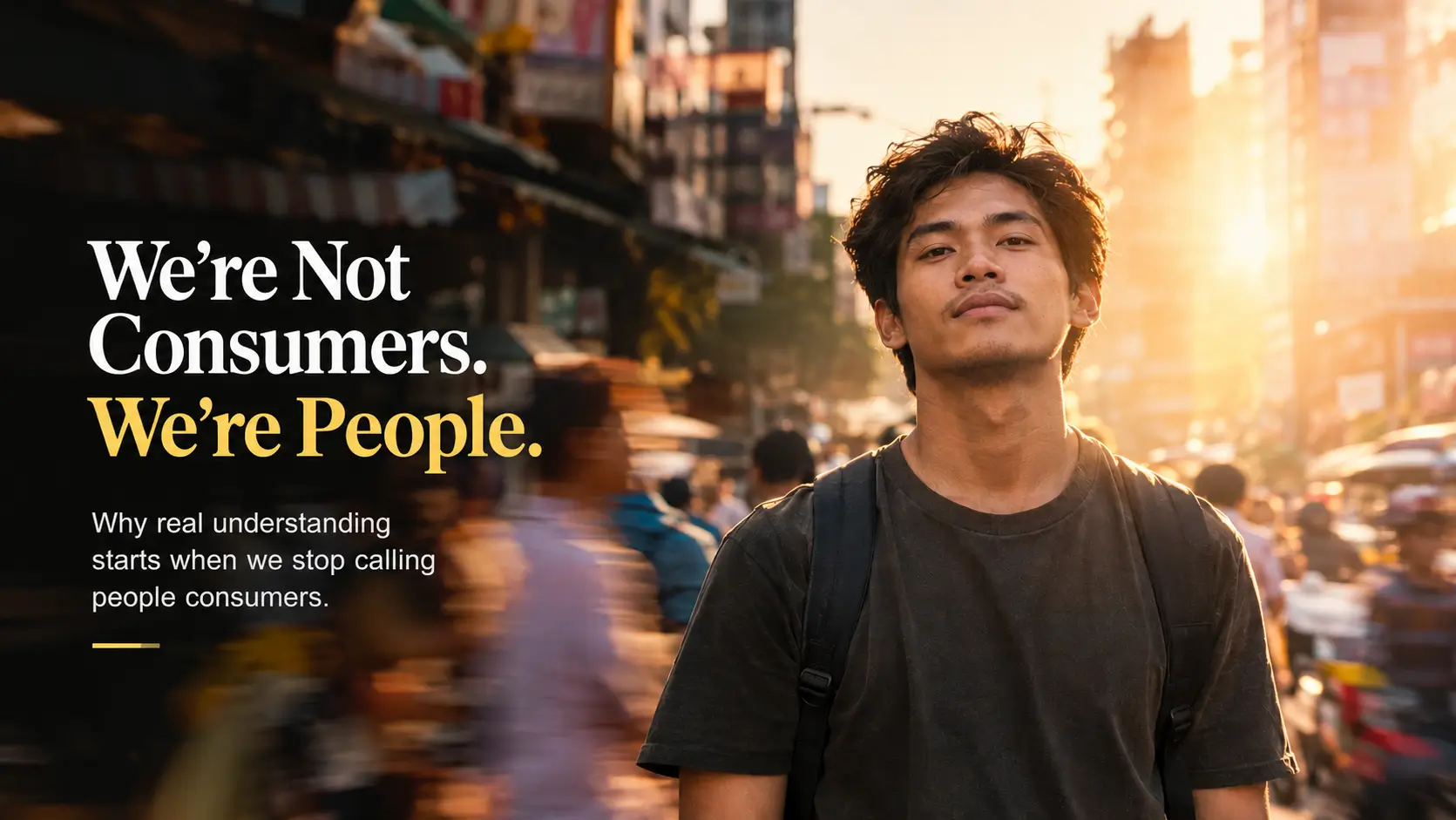
Don’t Dimmish People by Calling Them "Consumers"

"Hi! I am Dave and I am a consumer"
If you met me at a meeting, at a party, in a bar or on the street, and that was how I introduced myself, you would think, "Weirdo!!"
We don’t think of ourselves as consumers.
We think of ourselves by our names, as individuals, as people. A consumer sounds too generic, too distant, too weird. And yet I bet you often use that lazy language that has led to lazy thinking … typical of a marketing world (and now, unfortunately, a broader world) that tries to dehumanise people. Because “people” are too complex, too hard. Use the term “consumer” and it all becomes one easy to understand facet … not the whole person. The whole business world has fallen into that bad habit.
“Consumer insights”. “Consumer journeys”. “Consumer segments”.
Consumer this, consumer that. As if a human being wakes up in the morning, stretches, and thinks, "today I shall be a consumer and that will define everything about me". Here is simple clue to better marketing, better market research, better business: they do not. People wake up as a person, and they stay a person, and the word "consumer" is something the industry has lazily wrapped around them because it is easier to file a human life under a transaction than to actually understand it.
The greatest insight I have learned?
Back in 1999 I was president of McCann in Thailand, and, like a lot of people who think they are terribly clever, I had an idea to try and get all my staff involved in understanding the marketplace. So, I did what any slightly manic advertising agency boss would do. I sent all 120+ members of staff out onto the streets of Bangkok for a day. Here are 5 questions, I told them, go and ask random people what they think. Talk to strangers and find out what is actually going on in their lives (maybe a practice you could all try).
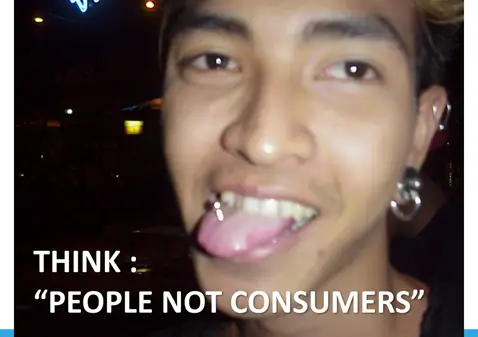 One team member approached that young guy in that fuzzy photograph above. She asked if she could talk to him, he said yes. She started the first question: "As a consumer, what do you …" and before she could finish, he stopped her. Flat. Cold. And he said, "I am NOT a consumer. I am a person."
To this day, it's the biggest insight and aha moment of my career. Not because it was polished. Not because I could put it in a deck. Because it was true, and because a stranger on a Bangkok street said what every person on the planet would say if we bothered to listen.
Here is the distinction, and it is not complicated.
We are consumers when we are in the act of consuming. Actually, using the product or service. That is it. For 99.9999% of our lives we are not consumers, we are people. And any smart marketer does, or should, know that the 99.9999% is the more important part. It is where the decisions get made, the feelings live, the fear sits, the desire burns, and the thousand small things live that have nothing to do with your brand and everything to do with why someone might, on a given afternoon, reach for it.
People who know me know I have drunk at least a Coke a day every day for 55 years. Yes, every day since I was 15. Never diet, never zero, never the fake ones. As loyal as you can get. But here is what you need to understand: Right now, as I write this, I am not buying or drinking a Coca-Cola. So right now, I am not a Coke consumer. I will be when I have lunch later today, but not now. I have also worked on the brand for over two decades, so I know just about all there is to know about it. I do not drink it because of the ingredients. I drink it because it has always made my life sparkle a bit. Yes, all you advertising cynics, that is true. Coke works because it has always understood me as a person who sometimes wants a little sparkle, a little happiness. Because I am a person and one thing that really matters to me is trying to be happy.
And that simple insight, that we are people and not consumers, is really what I have built my career around.
The whole point of BIBLIOSEXUAL, yes, I know it’s a strange name; look it up, is finding the intersection of what matters to people, what a brand can offer to what matters to them and what matters about the mediums they use.
#whatmatterstopeople.
Not what matters to consumers as they consume a product.
What matters to people. It is a small shift in words and a complete shift in mindset. Because the moment you stop calling them consumers you are forced to ask better questions: what matters to them? What are they looking for? What excites them? What do they trust? What do they fear?
Take media. People apply the same emotional judgement to a newspaper, a social media platform, or any medium that they apply to a brand or a person. The same article in the New York Post and people think, "Oh, it must be crap." The same article in The Economist and people think, "It must be worth something." Nothing about the article changed. The human reaction did.
That is not rational. It is almost impossible to find people who look at things rationally about anything. People react emotionally, and if you are talking to them as "consumers" you will keep missing the emotion that is actually driving them. Because what matters to people is nearly always based on and driven by emotion.
This is why I go on about life stages instead of generations. "Generations X, Z, Aplha, etc." is a myth we invented to put people in boxes.
Millennials do this, gen z does that. Nonsense.
A 24-year-old who is a parent of two and working three jobs has nothing in common with a 24-year-old living at home studying, even though we slap the same generational label on both. What actually counts is the life stage they are in and what matters to people as they pass through it. Are they becoming a parent, leaving home, caring for an ageing parent, or starting over after a loss? Those are the things that shape what people think, feel, desire and fear — not the decade they were born in.
And here is what happens when you respect that, when you tell the story to people rather than at consumers.
You do not have to invent a new story in every market. It is not about telling a different story. It is about telling the story about what matters in specific ways that matter. I worked on Mastercard's "Priceless" campaign when it launched in 1998. The original American ad was a father taking his 10-year-old son to a baseball game for the first time: the cost of the tickets, a hot dog, and a souvenir hat all mattered, but it is the experience that is priceless. Then we told the same story in India with cricket, in New Zealand with rugby, and in Argentina with soccer. The story did not change. The human reaction we were after, a parent and a child, a moment you cannot put a price on. That stayed. What changed was the culturally relevant way of making a person feel it. In Australia, baseball would have landed flat, because Australians think baseball is something Americans play and, well, who cares? Cricket matters there, Aussie Rules matters, Ruby League matters. People feel the emotions they create universally, the people experience of that is based on local culture.
Not a consumer experience. A people experience.
Look at Nike. "Just Do It". The line has not changed in decades. The swoosh has not changed. What changes is the way they illustrate it. Different audiences, different countries, different sports, different attitudes, different people. The brand adapts just a little bit to fit in just a little to what different people aspire “to do”. The emotion that drives the brand is all about understanding people.
That is what great brands do. Coca-Cola, L'Oréal, Apple, Patagonia, you could name 100. They hold the human, people, and truth steady and change the expression.
Great brands are built on understanding people, not consumption habits.
Great market research is not about discovering the trivia of consuming, shopping behaviour but about discovering #whatmatterstopeople. So, challenge yourself, your market researchers, your clients to not use the word consumer and think people instead. Focus on what matters to them as people and see the difference.