
The More Intelligent AI Becomes, the More Human Research Needs to Be

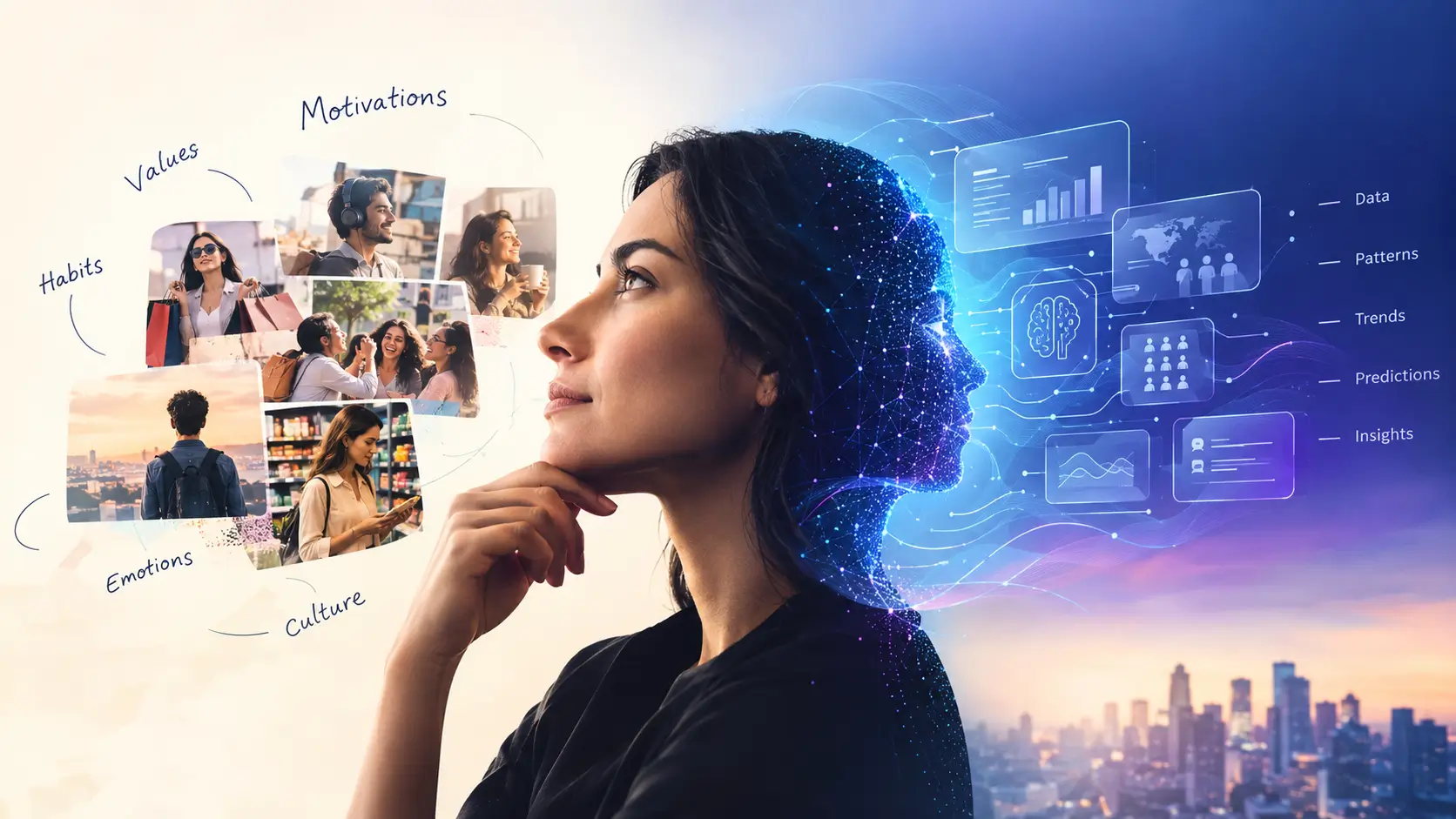
I have spent more than two decades trying to understand why people do what they do, and if there is one thing I have learned: People are terrible at being predictable! They say price matters, then buy premium. They say sustainability is important, then choose convenience when they are tired, rushed or hungry. They say they want more choice, then feel overwhelmed when they get it.
For researchers, this contradiction has always been frustrating, but to be honest, it is precisely this conundrum of decision making, which also makes our work fascinating.
Skip to 2022, now AI has entered the room and all of a sudden, everything seems to have become speedier, easier and more effortless.
For instance, we can analyse thousands of conversations in minutes, summarise interviews instantly or track cultural signals at extraordinary scale. You can model audiences, simulate their responses and create synthetic consumers...
Isn’t it extraordinary!
Although, it also raises a pertinent question, that I think our industry needs to confront boldly: ‘Are we becoming better at understanding people, or simply faster at describing them?’
The answer is where the difference lies, and it’s going to be of great implication.
For most of my career, consumer understanding came with friction. We had to go looking for that insight, sat and listened to the consumer for hours together, observed the unspoken hesitation, the contradiction between what someone said in the first ten minutes and what they admitted forty minutes later.
You saw the difference between claimed behaviour and actual behaviour; research required patience!
Today, increasingly, insight arrives as an output. You ask a system why a brand is losing relevance and within seconds you may receive ten reasons, three audience segments and five strategic recommendations.
The language is polished! The logic appears sound! The answer feels complete!
And that, ironically, may be the problem, as the most dangerous insight is not always the obviously bad one, sometimes it is the one that sounds completely right.
This matters because we are increasingly trying to model humans through data; age, income, purchase history, search behaviour, media consumption, sentiment, transactions…. Basically, enough variables together and we are confident of having reconstructed the person.
The reality is, NO! we have not. We have reconstructed their footprint and there is a huge difference.
Human decisions are shaped by things that do not always appear neatly in datasets, it lies in their hidden motives, fears, sense of identity, aspirations, habits and cultural influences.
For instance, two people can buy exactly the same luxury handbag, the transaction looks identical, but for one person, it may represent status; for another, reward, and for the third, belonging.
The data records one purchase. The human story contains three completely different meanings, and interestingly brands compete in those meanings.
This Is Why I Am Excited About AI, and bear it, I am not making an argument against AI, rather it’s quite the opposite.
I think AI represents one of the most exciting moments the insights industry has experienced. For years, one of our biggest limitations has been scale and opportunity to connect different worlds.
Imagine consumer intelligence built not around one research project, but around an evolving understanding of people : rooted in real behavioural data, qualitative conversations, cultural context, implicit signals and can be continuously updated and interrogated.
That is not simply faster market research, it is a fundamentally different model.
And instead of starting a project, we could in the near future, make consumer understanding something far more continuous, like an always on system; an intelligence layer, a living system organisation can engage with every day.
This can be incredibly powerful, but only if we build it properly and the risk is building synthetic certainty.
Digital twins and synthetic consumers are already becoming part of the research conversation. The potential is enormous, but I think we need to resist the temptation to believe that a digital representation of a consumer is the consumer.
It is not. At best, it is a model, and models are useful because they simplify reality, but they are dangerous when we forget that they simplify reality.
A digital twin without qualitative depth may know what someone usually does while having very little understanding of why?
The belief that because the answer arrives quickly and convincingly, there is nothing left to investigate; there should always be something left to investigate, as that is where insight begins!
The Researcher's Job Is About to Change
People frequently ask whether AI will replace researchers. I think the more interesting question is: What happens to our value when information becomes abundant?
If everyone can generate ten hypotheses in thirty seconds, generating hypotheses is no longer the scarce skill. So, what becomes valuable? It’s the human intelligence, the judgement, the curiosity, and cultural intelligence. The ability to connect seemingly unrelated signals. The instinct to notice when something feels too neat, and, most importantly, the ability to ask the next question.
Researchers have traditionally been trained to find answers and i increasingly believe our future value will come from our ability to challenge them. Why? What are we assuming? What is missing? Whose perspective is absent? What does the consumer say, and what does their behaviour reveal? What changed culturally?
Maybe “Market Research” as a term is limiting us and our future… What organisations increasingly need is not more research, but better decisions. This means consumer understanding must connect with business understanding.
The biggest opportunity AI gives us, is not to remove humans from research; but to remove some of the mechanical work so humans can spend more time doing what machines still struggle to do exceptionally well: making sense!
After more than twenty years in this industry, I find that possibility energising. Because despite everything that has changed — methodologies, technology, platforms, datasets, dashboards, neuroscience, automation and now AI — the most valuable question in consumer understanding remains remarkably simple.
It is the question I started my career asking, and I suspect it will still be the question we are asking long after today's AI tools have been replaced by something even more powerful.
Why are people really doing what they are doing?
The future of insights may be artificial intelligence. But its subject will always be human.
Related perspectives
-
Don’t Dimmish People by Calling Them "Consumers"
Dave McCaughan